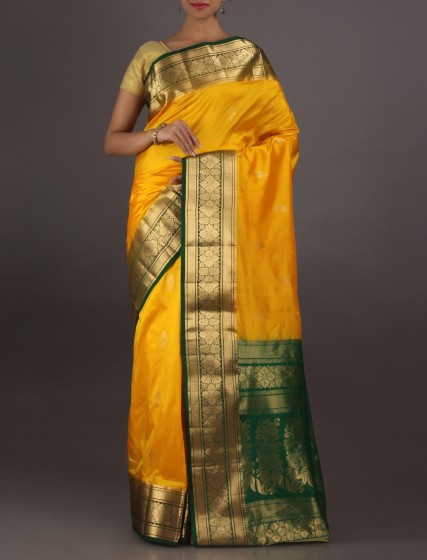
Shatika Handloom Saree

Wednesday, March 22, 2017

The Five Best varieties of the Indian Handloom Silk Sarees of South India

Destination South, the part of India that alone produces more than 50 varieties of silk fabric, South India is the sacrosanct of silk sarees. The handloom silk sarees woven in this part of the country is not just popular across India but they are always in demand all over the world. Displaying a large variety of creativity in their weaving techniques, motifs and designs, today Shatika brings you the five best varieties of the Indian Handloom Silk Sarees of South India:
1. Kanchipuram silk sarees: Stamped as the finest and the most exquisite silk sarees of the country are the Kanchipuram silk sarees from Kanchipuram, a small town in Tamil Nadu near Chennai. Loaded with rich cultural heritage, Kanchipuram is one of the oldest weaving hubs of the country. Woven using the 4ply technique, the weaving of Kanchipuram sarees is rather unique.These silk sarees that are noted for their texture, glimmer, permanence and refinement are the torch bearers of our rich culture and opulent tradition.

2. Gadwal Silk Sarees: Gadwal which is in Telangana state of India is famous for its Gadwal silk sarees, which with their exquisite zari work and well-crafted Kuttu borders and pallus command great admiration and demand throughout the country.The whole process of weaving Gadwal sarees is painstakingly carried out manually in an interlocked-weft technique.Their remarkable trait of getting folded down to the size of a matchbox makes these Gadwalsarees legendary to India.

3. Pochampally Silk Sarees: Spread over an attractive corner of the Deccan plateau, Pochampally is a well-known weaving centre in South India. Popular for its centuries-old weave in ikat style of dyeing, the uniqueness in the Pochampally weave relies on the transfer of design onto the warp and weft first, which are then woven together to get the required design. All this results in vivid and geometric designs that are a visual delight to look at.

4.Mysore Silk Sarees: Mysore silk sarees that come in suave colors and the trademark gold lace borders hail from culture rich Mysore of Karnataka and are considered to be one of the purest forms of silk sarees in the country. Featuring exquisite colors, soft silken texture and minimalistic designs, they are a symbol of class and sophistication.

5.Bangalore Silk Sarees: Bangalore silk sarees hail from Bangalore, a place considered to give impetus to the silk industry in India. Popular for their simplicity, purity and fine texture of silk, these sarees come in exhilarating borders and pallu in contrasting colors. Through rich zari motifs, woven patterns, and designer zari borders, Bangalore silk sarees are known to create a festive aura.

Tuesday, March 21, 2017

Alia Bhat is a beautiful Silk Saree at Zee Cine Awards

Alia Bhatt, the Youth Icon Walks the Red Carpet in a Silk Saree

The year 2016 in Bollywood was all about women power and one actress who absolutely and undeniably stood out this year was Alia Bhatt. Essaying a variety of roles from breezy ones like girl-next-door in Kapoor & Sons to some intense performances like in Udta Punjab and confused and complicated youth in Dear Zindagi, Alia Bhatt all of 23 has been there and done that. Not only has she shown a promising growth path since the time she made a debut in Bollywood with Student of the Year but she has also let this upswing growth show in her dressing.
A sartorial dresser who is known to blend style and comfort rather effortlessly, she has only upped her style quotient by walking the red carpet of the Zee Cinema Awards 2017 in a pure silk saree. Not only did she sweep away the best actress award at the award function, she also swept people off their feet on the awards night with her dazzling traditional looks and emerged out as the best-dressed female at the award function!

Looking exuberant and dignified asAlia Bhatt walked on the red carpet in a pink and peach colored silk saree, putting all the western gowns in humdrum, she brought a breath of fresh air in the mélange of western red carpet ensembles.
Alia gracefully adorned her saree with pretty pink flowers in her neatly tied bun, Alia and accessorized it with a pair of jhumkis that added sheer elegance to her getup. A youth icon that she is, we hope our younger brigade takes a cue from her on this dynamic dressing style and hope to see more and more of them in sarees, representing our traditional outfit on the global platform too.
Image courtesy:
http://bit.ly/2ne10Eb
http://bit.ly/2nJZYO0

Wednesday, March 15, 2017

Handloom Sarees of Andhrapradesh


Diverse Weaves of Andhra Pradesh
Laden with talent, Andhra Pradesh is known for handloom work. The state that has maximum number of weaving clusters in the country, the weavers here are known to manufacture exclusive sarees with intricate and distinctive designs. The tradition of weaving is an age-old profession of the state and this countless years of experience reflects in the sarees woven here that are not only most exquisite but generically and uniquely designed. There are many unique styles of weaves that come from the looms of this state that are worn by women all over the country. As the sarees get their names from the place they are woven at, the variety of sarees that are churned out from Andhra Pradesh are Pochampalli, Gadwal, Venkatagiri, Dharmavaram, Narayanpet, Mangalgirietc. These places in the state are very popular for their handloom cotton and handloom silk sarees all over the country.
Gadwal Sarees:
Gadwal is a popular center of traditional sarees in Andhra Pradesh. Stylish yet graceful, these sarees are quite unique for in these sarees, the sari body is made from cotton while silk is used in its border and pallu. Mango motifs are predominantly used in the sari designs. A mix and match of vibrant and festive colors like yellow, beige, parrot green and pink adorn these sarees. The most popular weave among all the weaves from Andhra Pradesh, these sarees from Gadwal are also referred to as the queen of sarees of Andhra Pradesh. Weft designs are particularly used in these saris that use interlocked design referred to as “Kupadam” or “Tippatiamu”. Temple motifs referred to as “Kotakomma” or “Kutabham” is used on the sari border and these sarees are specially worn during pujas. Festivities and religious events are incomplete without these sarees in Andhra Pradesh.

Narayanpet Sarees:
Bordering around Karnataka, sarees from Narayanpetin Andhra Pradesh bear lot of resemblance with sarees from Karnataka. Dark and earthy colors adorn these sarees that are made in silk and cotton. Eye catching patterns and intricate borders woven in dark shades like maroon, dark red or chocolate brown are very popular.

Pochampally Sarees:
Ikat weaving is one of the most popular handloom weaving styles in Andhra Pradesh that is mainly practiced in Pochampally. Using tie and die techniques in yarn, Pochampally sarees are made from yarns that are first dyed and then woven to make unique geometric designs in brilliant colors. Cotton, silk cotton and silk, all three varieties are popular in this weave.


Venkatgiri Sarees:
In silk and cotton, Venkatagiri saris are woven with pure silver zari and brocade designs in the border. The graceful strains of gold can be found all over the sari. These saris come in pleasing colours and they showcase dainty zari motif slike golden dots, leaves, parrots or even geometric designs.

Dharmavaram Sarees:
Broad borders with solid colors and contrasting pallus woven with intricate golden zari brocade characterize Dharmavaram sarees.Woven in interlock-weft technique, these sarees in silk and cotton are characterized by their softness and strength and are the most attractive and desired wedding sarees.

Mangalgiri Sarees:
A great compilation of exemplary designs, superior silk and exuberant color combinations, Mangalgiri Silk Sarees are woven in silk, silk cotton as well as pure cotton. Traditionally woven on pit loom from combed yarn by warp and weft interlacing, these sarees come in characteristic Nizamborders.

Image courtesy:
http://bit.ly/2nn8Pbg

Saturday, March 11, 2017

The Nine varieties of North Indian Sarees for the Handloom saree lovers


Chikankari Sarees from Lucknow, Utter Pradesh:
The most elegant and graceful hand embroidered sari among the North Indian handloom sarees is Chikankari Sarees from Lucknow, UP. The art that came to India from Persia and patronized by the Nawabs for many years, the design motifs in Chikankari are predominantly influenced by Mughal art. The bel or creeper is the most commonly used design while individual motifs or butis like that of animals and flowers are also made including fish (mahi), hathi (elephant) and kairi (mango), dhaniya patti (coriander leaf), murri (grain motif ), jaal and many more.The designs are graded and used according to the stitches employed. There are about 40 different stitches in Chikankari. Each stitch has an individual name and it involves a specific number of threads and has a specific use. Finely detailed designs with floral patterns are characteristic of this work.

Banarasi Brocade sarees from Varanasi, Utter Pradesh:
Even today, one can see the glimpse of India’s golden era in the opulence of North Indian weaves especially the Banarasi brocade sarees that are woven in fine gold and silver threads in the city of Banaras, Utter Pradesh. Fine heavy gauge silk yarns are woven intricately as warp and weft along with gold and silver threads called zari to create elaborate brocade designs. Most Banarasi saris reflect ancient Mughal influence that can be seen in the motifs used like floral and foliate motifs (kalga and bel), a string of upright leaves (jhallar) as well as other motifs inspired by flora and fauna as well as figures with detailed scenes from villages or designs inspired from architecture of temple and mosque, etc. There are a variety of Banarasi saris namely zari brocades, tanchoi brocades, amni brocades, tissue brocades, jamavar, etc. Today Banarasi saris are available in four kinds of fabric: pure silk (katan), organza (kora), georgette and shattir.

Dupion Silk Sarees from Banaras, Utter Pradesh:
Also referred to as Dupioni, Dupion silk sarees are medium weight silk sarees that are woven in Northern India and are widely popular throughout the country. Dupion meaning two, dupion silks are woven from cocoons that are formed jointly by two silkworms. It is a crisp and textured silk that is produced by using fine threads in the warp and uneven threads reeled from two or more entangled cocoons in the weft, creating tightly-woven yardage attributing to their textured look with unparallel lustre. Often woven with different colored threads that are scattered through the warp and weft, these sarees exhibit an iridescent effect that combined with their stubby texture gives them a very rustic and natural look. Dupion silk sarees come in a variety of plain and striped patterns or floral and other intrinsic patterns which clubbed with their colourful weave bring out the beauty of the saree like none other.

Chanderi Sarees from Chanderi, Madhya Pradesh:
Chanderi silk sarees from North India are one of the traditional methods of hand-weaving that have been developed over the centuries and passed down through generations. These saris are very light with unique glossy transparency. Made in either cotton or silk or silk-cotton, the patterns seen in these sarees are inspired from the temples of Chanderi. These sarees are mainly distinguished by their borders. These saris are known for their contrasting colors and their distinct nature as well as temple inspired patterns.
Bafta Sarees  from Madhya Pradesh:
Bafta sarees from Madhya Pradesh are popular for their beautiful subdued prints on natural earthen colors. Made in silk-cotton fabric, these sarees are a fine mix of lustrous silk in the warp and mercerized cotton in the weft. Combining the best of both worlds, these illustrious sarees have a natural glow that gleam with sophistication. These sarees feature fringed pallus in grand traditional style that are rather suave and understated, giving the wearer elegant looks.
Maheshwari Sarees from Maheshwar, Madhya Pradesh:
The simple and elegant Maheshwari sari from Maheshwar, Madhya Pradesh is another ancient celebrated weaving cluster from North India. The typical Maheshwari sari is either checkered, plain or with stripes, combined with complementary colours. Mostly woven in cotton and silk, these saris have a trademark border and pallu that set them apart from the likes of Paithani, Patola, Kanchipuram and Gadwal. Trademark of Maheshwari sarees, the pallu is particularly distinctive with 5 strips, 3 coloured and two white alternating, running along its width. The border of the sari known as bugdiis reversible making the saree rather unique.

Kosa Silk Sarees from Chhattisgarh:
One of the most popular sarees in North India that are much loved for their beauty, comfort and sturdiness are Kosa silk sarees from Chhattisgarh. Woven by the Dewangan tribe which resides in the Gondwana forest belt, these sarees are greatly influenced by nature and tribal designs that are seen on these sarees, setting them apart from the modern day designed sarees.As Kosa silk is obtained from a special type of silk worm called Kosa that is rather rare, the texture of these sarees is coarse. This unique feature makes them stand out in the crowd of smooth silk sarees of North. Kosa sarees come in natural shades like pale gold, fawn, cream, honey, orange and so on. Natural dyes are used to create interesting designs along with dyeing the entire saree. Popular designs that adorn these sarees are patterns like the Jaala (net) and Fera that are inspired by nature along with other interesting designs like tribal tales and mythological stories adorning them. Kosa sarees are considered pure and pious and they make a great wear for important occasions like weddings and religious ceremonies.

Bagh Print Sarees from Bagh, Madhya Pradesh:
From a near forgotten tribal art in a small village in Dhar district of Madhya Pradesh, today Bagh printed sarees are amongst the most admired north Indian sarees in the world. Made using block printing based on traditional motifs inspired by the 1,500-year-old paintings found in caves in the region, the motifs seen on Bagh print sarees include chameli or jasmine, maithir or mushroom, leheriya and jurvaria or small dots on the field. Apart from the various moods and landscapes that these motifs emote, the prints have a distinctive feel that no machine print can ever evoke. Also these sarees are known to be extremely soft due to their repeated washes in river Bhagini. The block printing process is rather long and tedious and involves first in soaking overnight of the fabric such as cotton, tussar, silk and crepe which is then dried only to be soaked again in a special paste that is once again washed, bleached and dried thus making it ready for printing. Block printing also is very laborious and needs human perfection to create a uniform design and in turn a perfect drape.
Batik Print Sarees:
An art of decorating sarees using wax and dye, Batik printing is a creative medium to adorn sarees that is prevalent in North India. In India, it originated in Gujarat in the 1st century AD by the Khatri community. Considered till date as the most expressive and subtle of the resist dye methods, the process of making Batik involves selecting areas of the cloth that are blocked with hot wax and then dyeing the cloth. This way the parts covered in wax resist the dye and remain the original colour. This process of waxing and dyeing is repeated multiple times to create more elaborate and colourful designs. After the final dyeing, once the wax is removed, Batik print saree is ready for wearing. These days, Batik printing is done on a variety of sarees like cottons, silks and georgette.

Indian Colourful Handloom Sarees


Sathrangonkitolilayihai Shatika iss Holi!
Color and variety are synonymous with Indian culture, its beliefs and its way of life. A country steeped in traditions, India charms and bedazzles the world with its kaleidoscopic colors. Symbolic of this colorful extravagance is Holi, the festival of colors. Colors are the most joyous part of the Holi celebrations. They add life and vitality to the festival making it most vibrant of all. The very sight of this festival is so beautiful to watch, the one that fills the atmosphere with the clouds of colors! A festival that celebrates victory of good over evil and a celebration of the arrival of spring and harvests to come, Holi is the festival of colors, emotions, and happiness and what better way to express these feelings that you are going through right now than to deck out in these vibrant colors yourself! Today Shatika brings you innumerable handloom sarees in a parade of seven colors and aptly calls it – Sathrangonkitolilayihai Shatika iss Holi!
Red: Red is the color of love, sensuality and purity. Perhaps the most ceremonious color in the life of an Indian woman, it is the color of weddings and festivities. Simple and subdued with minimal work or bold and bright with heavy work done, color red rules Shatika’s  wide spread collection of sarees.

Blue: Color that signifies trust and peace, Shatika offers you indian sarees in multitudinous shades of blue feel in tune with nature with sober and pale blue sarees or feel electrified with striking vibrant blue sarees. Do not let your mood decide the shade, rather let the shade decide your mood!

Green: Color of growth and renewal, green symbolizes self-respect and well being. Shatika brings an array of sarees in various shades of green-grass green, moss green, bottle green, henna green, take your pick and let your attitude reflect in your sarees.

White: Color of purity and innocence, white signifies wholeness and completeness. Feel whole and complete with our collection of breathtaking sarees at Shatika, in shades of white. With these wondrous sarees, we bet you will not even feel the need to accessorize!

Black: The color of power and strength, Shatika brings a range of power packed black sarees that reflect your confidence and tell the world what a power house you are, irrespective of the innumerable textures and patterns they come in.

Yellow: Optimistic and cheerful, yellow is the color of bloom. Refresh your senses with a blossoming collection of yellow sarees at Shatika, in a variety of textures, designs and patterns. Who says making a choice is easy!

Pink: They say lovers of beauty favor pink. An ardent fan of beauty, Shatika favors pink in all flavors; from blushing pale pink to bright fuchsia pink, we bring sarees in all shades and styles for all you beauties out there!

Image courtesy:
http://bit.ly/2mLRhV8

Tuesday, February 28, 2017

Innovative Blouse Designs for Traditional Indian Handloom Sarees

One of the oldest Indian style statements, the saree is constantly undergoing a transformation and innovation every season. The reason it has survived the changing fashion trends is because of its ability to evolve in various cultures and regions at different times. With changing times if the focus once was on different kinds of drapes and fabrics, in current times it is about pairing these six-yard wonders with fusion blouses in modern cuts and silhouettes. Handloom sarees too are coming up with looks that are more identifiable with the younger generation. These even green traditional attires paired up with unconventional blouses are redefining the beauty of handloom sarees and that of modern women. Whether it’s the peplum tops or raglan sleeves or simple collared neckline, these innovative styles add a modern twist to the traditional garment. Today, we bring you few ideas of innovative blouses that you can experiment with for all those traditional handloom sarees sitting in your wardrobe to come out in style.
Tux Jackets:
The saree suit as it may be referred to, wearing a formal well-fitted tux jacket as a blouse and draping a neat khadi silk saree or a linen silk or jute silk saree over it may be a great way to wear the ‘east meets west’ look. The key to carry such a retro look is to go for a suit in a color that compliments the saree. Avoiding classics like black and white and also playing with the length of the sleeves like instead of full sleeves going with a three-forth length will surely go a long way in getting the perfect trendy look.

Peplum Tops:
Taking a break from conventional cholis and recycling an embellished peplum top into a saree blouse may be the thing to do for some effortless glamour. Plain bold colors can be clubbed with classics like colorful floral patterned chanderi silk sarees or even vivid pochampally and patola silk sarees.
 
Retro overcoats:
Add some old world charm to your saree while still making it look trendy and fashionable, with an overcoat reaching up to the knees that were fashionable back in the 40s and 50s. paired with plain silk sarees, you can bring in some festive look by going with heavily brocaded traditional banarasi overcoats. For summers, go for light breathable fabrics like Sonam Kapoor’s unconventional lace sari-embroidered jacket at the Cannes red carpet back in 2013.
Capelets:
While flowing capes was the fashion standout last year when celebrities wore them on western outfits, it’s time to incorporate them into the traditional garments this year. Shorter in length and well embellished, sheer capelets over a plain georgette or chiffon saree look stunning. In contrast, plain capelets on embroidered sarees like lucknowi chikankari sarees or kantha work sarees or hand painted vibrant sarees like kalamkari sarees or madhubani sarees are a great option.
Collared blouses:
One can team any funky collared blouse with a saree. This style is a favorite among young women and can be worn in multiple ways like a shirt, blouse or a jacket. One can add epaulettes, roll up sleeves, add a pocket on sleeve or even zippers for a formal look. These blouses generally complement one toned sarees like khadi or silk saree and are a great option for corporate women.
Image courtesy:
http://bit.ly/2luwzWg


Tuesday, February 14, 2017

Valentine’s Day Sarees – Increase your Style Quotient with Fabulous Sarees

The most romantic day of the year is here the day that marks celebration of romantic love, friendship and admiration! This is one day that is celebrated the world over by sending messages of love and affection to partners, family and friends. Whether you are spending the day with a special someone or getting together with friends, one thing that is on every girl’s and every woman’s mind is –how do I dress to kill?
Red is the color of the day and while there are many smart types of attire in the market in this color specially crafted for this day, nothing comes even close to the sensuousness of a saree! The most admired, adulated and attractive attire for a valentine evening, here are a few sarees that you may want to explore this Valentine’s Day to woo that special someone!
Chiffon Sarees:
Chiffon sarees in their soft feel, their flowy and light texture and their attractive colors are capable of igniting sparks of love! While their slippery texture will leave your Valentine weak in his knees, it will make sure your relation goes strong and long like itself!
Georgette Silk Sarees:
The sarees that are made from yarns that are highly twisted, these attractive and good looking sarees are apt to bring on a twist in the slow and boring Valentine date. High on desirability quotient, as they present themselves in a wide palette of colors and designs, they are a must have this Valentine’s Day!
Printed Silk Sarees:
An outburst of designs and colors, these vivacious sarees are perfect for kindling an outburst of emotions on a special day like this! Timid patterns and pale colors are not for today, today’s day is to flaunt your bubbly and cheerful personality with cheerful colors and bubbly patterns of a printed silk!
Chanderi Silk Sarees:
The sheer beauty of Chanderi silk sarees in subtle hues is all that it needs to recreate most memorable romantic moments! With them on, you don’t need much accessorizing too; after all, less is more on this day of love!
 
To dress up for a perfect Valentine evening, online shopping can help you in endless ways. Right from choosing from numerous options of sarees in new styles and trends to getting these gorgeous sarees at best prices! At Shatika, the new designs are proclaimed with great effectiveness for you to savor. Valentine’s Day is the celebration of love. Make it special this year for you and your loved one by indulging in Shatika sarees that are the most attractive sarees online and ensure your Valentine has eyes only for you this Valentine’s Day!